

👇 All PNW Adventures To Date 👇

This many mountains is just insane to me. Prior to this trip, this was not what I pictured when I thought of Oregon. This was downright RUGGED! And it was gorgeous. The three mountains in closest proximity to Black Butte, and to one another are the Three Sisters for which this area is named: Middle Sister, North Sister, and South Sister. All three of these mountains are sleeping volcanoes. The North and Middle Sister last erupted ~14,000 years ago and scientists think it’s unlikely that they’ll ever erupt again. However, the South Sister erupted as recently as 2,000 years ago, and could feasibly erupt again. There have been sporadic reports of volcanic rumblings deep within South Sister since 1866, and there have been a couple of minor scares since the late 1980s. Nothing has ever happened, but there is a big pot of magma a few miles beneath the peak of South Sister. Did I mention that South Sister is also the easiest of these mountains to climb? Sign me up for that!! 😵

Making our way out of the Cascades, winding through these forests was very cool, but to really understand why this region is so jaw-droppingly gorgeous, you have to zoom out. I don’t know what I expected to find out here, but it sure as hell was not a bunch of majestic snow-capped mountains! I had heard of the “3 Sisters” mountains before, but I had no idea just how large they loom over this area. Also, they’re not alone. There are a whole bunch of other peaks around them that make Central Oregon feel like a high-altitude fortress. THIS is where the Wild West still exists. Eastern Oregon/Washington, Northern Nevada, Idaho, Montana… there’s a whole lot of empty space out here. As somebody who has never lived west of the Mississippi River, it kind of blows my mind that all of this exists in the same country I live in. In the next 2 articles, we are going to get out into these mountains, so I am not going to explain much more of this right now. For now, the following gallery will have to be as mysterious to you as it was to me when I first arrived here.
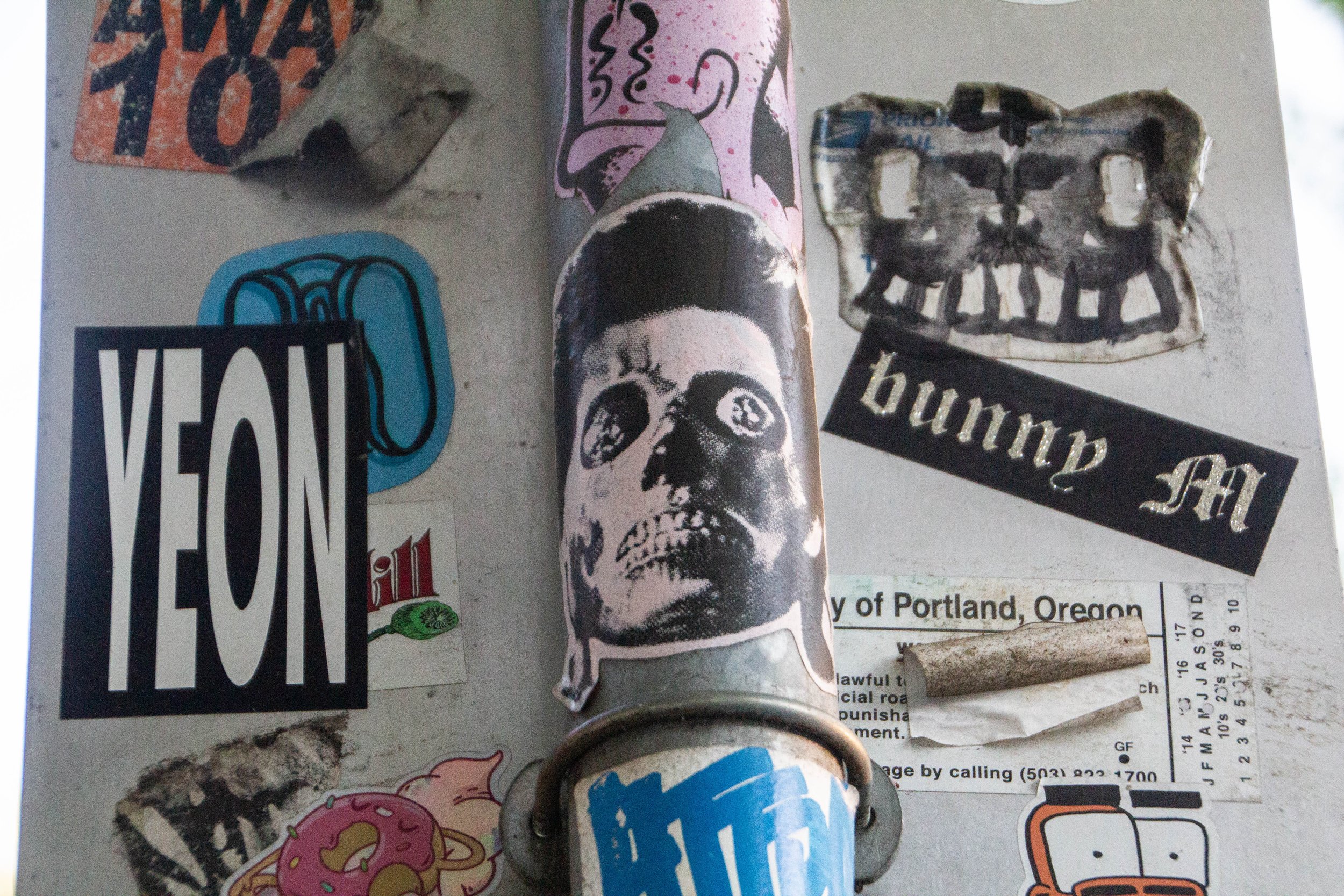
I’m going to do something a little different today. I love piecing together articles on street art wherever I can. It’s a great way to get to know a place! I had a hunch that Portland was going to have some really cool street art, but to my surprise and slight disappointment, I didn’t find quite the density of murals that I would have needed to merit a full article.
However, as I walked around the city, I began to notice that nearly half of all public surfaces that I walked past—be they street signs, telephone poles, or brick walls—were absolutely PLASTERED in stickers. And I’m not talking about some garden-variety smiley face stickers. Each of these was custom-made, artistic, and—for the most part—completely outrageous. Seriously, viewer discretion is advised. This collection of stickers would make my childhood pastor WEEP!

Portland is the southernmost major city in the Pacific Northwest, and, driving northward from Sacramento, it’s the next major slice of civilization you’ll find on the West coast. Although, I should clarify that Portland is not actually coastal. It is a “port city” because it sits at the convergence of two major rivers that are connected to the Pacific Ocean: the Willamette and Columbia rivers. It’s about a 1.5 hour drive to the Pacific coast, which leads me to another thing that I want to highlight about Portland: it’s proximity to nature. This is a common theme among cities in the Pacific Northwest—including Seattle and Vancouver. All of these places are great gateways to some incredible natural beauty. And Portland is no exception. With Portland as your “home base,” you can (for example) do day trips to 1) surf, 2) snowboard, 3) hike, 4) rock climb, and 5) sail on 5 back-to-back days. For the “outdoorsy” among us, it’s a great place to be.
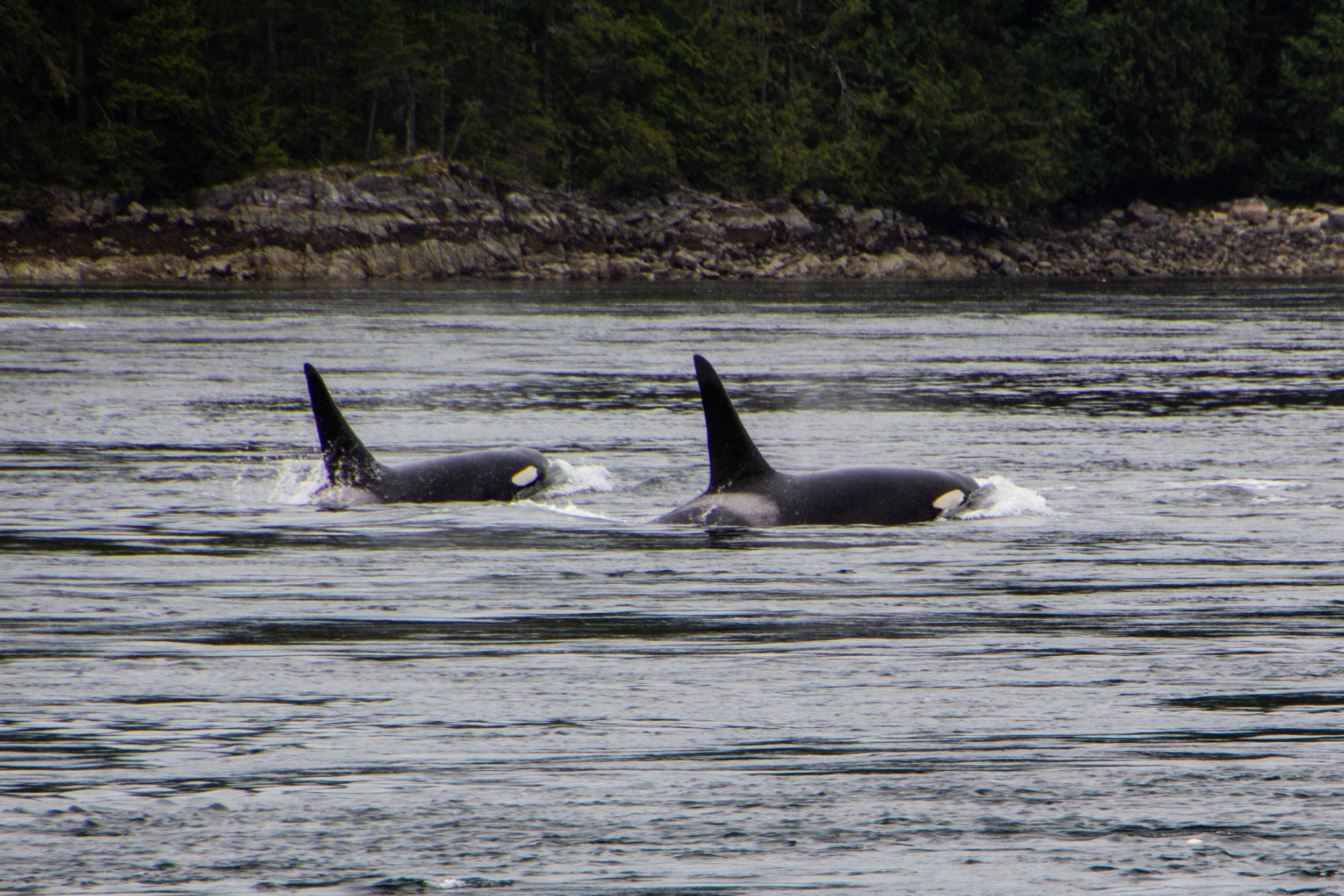
Orcas, or Killer Whales, were something of a feared creature in the olden days. Apparently, back in the 1800s when this part of the world was first being explored by Europeans, their technical/scientific classification was actually “Monster.” Hilarious as this might seem, it does make some sense. Black whales with sharp teeth and shark fins? Yeah, that would have definitely felt somewhat monstrous to me if I was an early sailor of these waters. The conventional wisdom of the day was that, if you fell in the water, you needed to get out ASAP so an Orca wouldn’t eat you. If you hadn’t already guessed this, there is, in fact, no record of an Orca ever eating a human. But this was still a legitimate fear as recently as the 1960s when they actually mounted a machine gun on a coastal bluff known as Chatham Point with the aim of shooting as many Orcas as possible. 🤯 Somehow, for the time when this gun was actively scouring the seas, the Orcas stayed clear of this area and there were no casualties. So Orca/human tensions have never escalated to be anything more than a cold war. And it was not long after this that human sentiments toward Orcas began to change for the better.

Cortes Island is perfect. I am not speaking figuratively. Literally perfect. Every little detail of this island was so effortlessly interesting, unique, and authentic… I don’t know that I have ever seen a place quite like it. It felt like I was living in a chapter of a book. It was like the entire place was straight out of a Wes Anderson movie. Think Moonrise Kingdom, but on an island off the coast of British Columbia, and mostly populated by adults. I could make a cool Pacific-Northwest-meets-Martha’s-Vineyard Pinterest board inspired by this place. Every property was tastefully weathered and clearly maintained with a personal, practical touch. There were no houses that screamed “VACATION RENTAL” here. Every single one of them looked like they were the active, primary residence of an eccentric gardener.

Our time in the wild, mossy forests of Western Vancouver Island is coming to an end. It’s time for us to make the journey northward toward a place called Campbell River. There are some really cool things in store when we get there, but before we jump into any of that, I wanted to share some miscellaneous exploits from our time between destinations. I often feel like it’s these “in-between” experiences where you really get to know a place, and Vancouver Island was no exception. The reason I feel like I “know” this place at all is because of the ground we covered in this article.

Avatar Grove is well-named; it really does feel like something out of Avatar. Or maybe Jurassic Park. It is a tangled, mossy labyrinth of ancient, knotted trees rising out of an infinite carpet of prehistoric-looking ferns. Each tree branch is draped with moss, similar to the way Spanish Moss hangs from every tree in Savannah—but in a green, lush, distinctly Pacific Northwest kind of way. Every little detail of this place was fascinating and photogenic. From the mossy, leafy forest floor, to the canopy high above our heads, every inch felt like its own world.

In the last article, we checked out Sombrio beach, which I think is likely the most easily-accessible stretch of coastline in the Port Renfrew area, and also the place that resembles the classic “beach” (i.e. sand, waves, etc) most closely. However, the majority of Vancouver Island’s coastline is not as easy to access and is NOT your classic sandy beach. This is a rocky, mossy, rugged, chaotic, windswept boundary zone, perpetually pounded with massive waves, riddled with lively tide pools, and entirely unaccommodating to the “beach vacation” experience. It’s also extremely cool.

To give you an idea of exactly how isolated this place is—the one gas station in the area was out of service during our visit, so we had to drive 2.5 hours EACH WAY to get to the next nearest gas station. We had been advised to stock up on groceries in Victoria before coming out here because we’d have to travel similar distances to find a supermarket. Also, Port Renfrew apparently experiences random rolling blackouts from time to time. When the power went out on our last day, we stopped by a local hotel & restaurant that had a generator running to ask how long these blackouts usually lasted—they told us that the last one lasted 2 days. 🤯 Suddenly, the flashlights we found waiting for us in our Airbnb made a ton of sense. That’s part of the deal out here!

“……Paraguay?” I asked through a confused squint. I did not recognize this name, but it sounded a bit like Paraguay, even though this guy was clearly not from South America.
“No… Haida (exaggerated pause) Gwaii.”
Google that. Google “Haida Gwaii.” I had never even heard of this place. And I have heard of most places.
That is the kind of place that Victoria serves as a way-point for. It’s a completely different world that awaits up here. But I’m getting ahead of myself. First, let’s take a walk around Victoria…

Making the jump from plain ol’ Richmond/Vancouver suburbs to historic Steveston happens unceremoniously. One minute you’re speeding through cozy residential neighborhoods, the next you’re slowing down as you drive along the docks. Having never been this far north on the west coast, my only reference points for what this place feels like were all about 2,000 miles eastward. Maine. Massachusetts. Nova Scotia. That’s what Steveston feels like.

We already talked about how close into the mountains Vancouver is. I have never seen anything like it—at least not for a city as big as this. Northern Vancouver is literally built into the sides of the Cascades, with its streets and buildings sloping up the sides of the mountains as far as physics will allow. So when you start driving northward from Vancouver, you will find yourself in the mountains pretty much instantly. The drive up follows the coastline of a rugged Pacific fjord that comes to a head in the gorgeous little town of Squamish, and from there it’s all mountains. Here’s a map of the trip. It might not look like a huge distance on the map, but’s 2.5 to 3 hour drive to get up there from Vancouver.

Vancouver is kind of a perplexing place because it mashes together a lot of puzzle pieces that don’t really seem like they should fit. Or at least, they didn’t to me. When I first arrived, I was having a sort of dissociative experience trying to piece it all together and make sense of things.
First off, there’s the location. Looking northward, Vancouver is built into a landscape that seems entirely impractical for a major city. It’s hard to believe just how close the northerly Cascade mountains are to the city. The northern suburbs of Vancouver literally slope upwards as far as physics will allow before you’re headed towards snow caps. 🏔

Say what you will about Vancouver—there’s no debating that it makes an impression on you. Its iconic glittery, sparkling, glassy skyline set against a backdrop of imposing, snowcapped mountains and moody gray skies is nothing if not striking. But there’s a lot more to this place than whatever this image conjures up for you. Vancouver is an unlikely swirl of old and new, of chic and grit, and of sun and rain. And it will serve as the base camp for our next series of articles.

And we’re back in mainland Seattle from our little trip over to Bainbridge Island! In our first installment, we checked off some of Seattle’s more obvious tourist attractions (i.e. Pioneer Square, Pike Place Market, the view of the Space Needle from Kerry Park, etc.). It was very cool, but TODAY we’re going to peel a few more layers off the onion and get into some of Seattle’s quirky b-list attractions. As a city, Seattle has a stronger and more distinct personality than most. I think this cross-section of less-notable items actually did more to help me get to know this place than the major tourist attraction did. It’s all about details.
SO LEMME HITCHU WITH THE DEETS.

I’ve heard Seattle described as “Portland’s mainstream older brother.” It’s true that Portland (Oregon) has long enjoyed a reputation for being one of America’s “weird” cities, as evidenced by its famous slogan, “Keep Portland Weird.” However…
I’ve been to Portland. My main man Buddy who accompanied me on this trip even lived there for a hot minute, and we both agree: Seattle is definitely weirder. In fact, I think I can conclusively say that there is more unabashed weirdness walking around the streets of Seattle than any other city in America. I’d be lying if I told you it didn’t make me feel uncomfortable a time or two (spoiler alert: there’s a nude beach in this article) but after some reflection, I think the problem is me. Because if you really think about it, the amount of weirdness walking around the streets of any city is likely the same no matter where you go. The difference is that, in Seattle, people feel empowered to be themselves. So they let their freak flags fly. And that’s pretty cool.

I’ll start with a quick introduction to Bainbridge Island. The first thing I should probably tell you about Bainbridge is that it’s not just some tourist haven—it’s actually a commuter suburb of Seattle. Lots of people live here! In fact, there are more islands out here than just Bainbridge, and many of them fall into this same category. Bainbridge alone has a population of about 25,000. I actually had a friend in college who grew up here, which now makes me jealous.

Some places hit you with vibes the second you step out of the airport. The air is different. The energy is different. Even the industrial in-between areas around the airport and the highway have a strong sense of character. Seattle is one of those places. In a happy twist of fate, I unwittingly ended up on the same flight to and from Seattle as one of my buddies in BNA, so I got the express pass into the city riding shotgun in the car that he had rented. Seeing the breathtaking Cascadian landscape unfold before us, I could not stop talking about how cool it all was. The mountainous terrain makes it so you are always either arriving at or leaving from a scenic vista, each of which provides a more gorgeous view than the last. Looking out in any direction, there are always multiple layers of water, city, and evergreen-dominated foothills between you and a background of MUCH larger mountains. And those mountains are always set against an expressive sky, which alternates between a clear, northerly baby-blue color, or a swirling moody mass of clouds.

Let’s start with size. Mexico City is really, really big. In fact, Mexico City proper has almost 9 million people and Mexico City metro is home to a whopping 21 million people, which just a few million less than Beijing. This makes it the largest population center on the entire continent of North America—bigger even than New York, LA, Chicago, Toronto, etc. It also puts Mexico City comfortably in the top 10 largest cities in the world.

Some cities hit you with strong vibes the minute you step out of the airport, and those vibes set the tone of your entire stay. But Tbilisi was an interesting one, because I really didn’t feel anything when I arrived here. Or ever, in the 7 nights I spent in this city. I was expecting some sort of strong, emotive, post-Soviet energy of a fledgling nation determined to get on its feet regardless of Russia’s endless attempts to undermine its sovereignty (or, you know, something like that) … but I felt nothing. Because, as it turns out, Tbilisi is a city with absolutely ZERO pretense.

Varanasi is known as the holy city. It is said that all the Hindu Gods live here. After finding enlightenment under the Bodhi Tree, Buddha came here to do his first teaching. There is also a sizeable Muslim community here. The city is therefore packed with religious landmarks and temples.
Chush Falls (pronounced “shoosh”) is actually nestled right up against the Sisters Mountains and Broken Top. The drive to get to this trailhead was about an hour from Tam McArthur Rim, all over gravel roads. Oh, and it was absolutely STUNNING. Honestly, even if you don’t do this hike, the drive is still well worth the effort. This was already bringing me closer to these mountains than I had yet been. Looking up at the snowy slopes, I could see every little rock and wisp of cloud clearly and was able to even capture some of this with my camera. And, miraculously, the weather really was clearer over here.