

As we all know, the streets of Paris are famously beautiful. But what you might not know is that just a few meters below these charming bistros and boulevards lays hidden a labyrinth of dark tunnels containing somewhere in the vicinity of 6 to 7 MILLION skeletons. These are the catacombs of Paris, and today—in the spirit of Halloween—we’re going down there. 🎃
But first, some context…
The Story of the Paris’s Catacombs
The late 1700s were an infamously unstable time in French history; you’ve probably heard a bit about the French Revolution in history class, right? This is our approximate historical context.
But, leading up to all that mishegas, Paris was dealing with 2 other problems that probably didn’t make it into your history book:
Centuries of limestone mining had left the ground underneath Paris unstable. Starting all the way back in Roman times, 320 km (200 miles) of subterranean tunnels had been carved underneath Paris to extract stone that would be used to build the city above. By the 1770s, cave-ins were becoming a very real concern, with entire Parisian neighborhoods at risk. There was a particularly infamous cave-in near Rue d’Enfer (“Street of Hell”).
Its cemeteries were literally overflowing with corpses. ~1,000 years of burials had turned churchyard cemeteries into disgusting biohazard zones. There were so many bodies that accumulated over the years that they had to be buried in layers, with older bones sometimes being crushed to make way for newer bones. The smell and decay of rotting corpses was so bad that nearby bakers claimed that the gases released by the decomposing corpses was seeping up through the ground and spoiling their food! Meanwhile, the earth around Cimetière des Innocents was apparently so rich in decomposed body fat that that it was actually collected and rendered into soap for industrial use. So, the bakers’ loss was the soap makers’ gain; Adam Smith’s “Invisible Hand” works in mysterious ways! Finally, in 1780, a wall collapsed under the pressure of rotting bodies, flooding somebody’s cellar with decomposing remains. The story goes that THIS is what finally prompted the city to take action.
To solve both issues at the same time, French authorities decided to convert these old mining tunnels into a giant tomb.

So here’s what they did. First, a new government department (Inspection Générale des Carrières) was established to map and reinforce these underground tunnels.
In 1785, the transfer of remains began from Cimetière des Innocents in Les Halles. Workers (poor laborers who worked in cemeteries and quarries) literally had to dig up every grave by hand, sort the bones, and load them into wagons for them to be wheeled across Paris under cover of night. It’s worth noting that there were also some “soft remains” in the mix from bodies that hadn’t fully decomposed yet, so that must have been extra disgusting. As many as 30 wagons per night were wheeled through the darkened Parisian streets to the entrance to the catacombs, which was (understandably) known as the Barrière d’Enfer (“Gate of Hell”). Accompanying these wagons were priests chanting prayers, which I’m sure brought this to a whole new level of creepiness.
The “Catacombes de Paris” were official consecrated in 1786, but the gradual transfer of bones continued for about 75 years, all the way to 1850, by which time about 150 cemeteries around Paris had been dug up, and lots of newly dead people had been added in real-time. The French Revolution happened in the middle of this (1793-1794) so there were lots of new entrants being added during that time, many of them guillotined.
So, who is buried down here? My understanding is that the idea of somebody being “buried” here is a bit more abstract that we would typically assume, because instead of marked graves to denote the location of a particular body… this is literally a pile of bones. It reminds me of the fairy tale of the Dragon that sat on the pile of bones at what is now a bus stop in Aix-en-Provence. This is basically a mass, unmarked grave. By the time they finished filling the catacombs, there were an estimated 6-7 million skeletons down here, which is all the more absurd when you consider that the (living) population of Paris was only about 700,000 at the time. This was damn near everybody who had ever died here in previous millennium.
To make this even more weird, in 1810, the inspector of quarries—a guy called Louis-Étienne Héricart de Thury—made a portion of these catacombs “visitor ready” by arranging the bones ✨artistically✨. The basic layout of these catacombs is that bones are stacked into wall-like rows that enclose narrow walkways. Behind these “walls” of bones, the rest of the remains sit in giant, shadowy piles. And onto the front of these “walls”, where space allows, femurs and skulls are arranged in some “artistic” ways. You’ll see examples of this in the gallery below, but I’ll tell you right now that I found the 14 skulls arranged into a heart shape to be a wee 🤏 bit irreverent. But then again, Parisians have consistently embraced the overwhelming macabre of this place in some… *ahem interesting ways. More on this to come!
With that as the pretext for what it means to be “buried” here… there are some interesting figures whose remains are said to be housed in the catacombs! In addition to Charles Perrault, who was the author of “Cinderella” and “Sleeping Beauty”, there were also some major figures from the French Revolution who are supposedly buried down here. In addition to Georges Danton (who was guillotined) and Jean-Paul Marat (died by stabbing), the bones of the infamous Maximilien Robespierre—who was a major leader during the French Revolution largely responsible for The Reign of Terror—is here as well. He died of natural causes. JK—he was also guillotined.
There’s a lot more to say about this, but I don’t think it will have as much impact if I haven’t first shown you how SUPREMELY creepy this place is. So let’s visit, shall we?


Tickets cost between €31 and €25, depending on whether or not you get the audio guide to go with your tour. And—this is important—you have to book the tickets in advance! You can do that here, on the official website. They have a great logo, right?
The spiral staircase that leads down into the catacombs is a lot longer than I had expected. By the time we reached the bottom, the air was cold and damp. And we quickly found ourselves in a series of seemingly unending underground tunnels. The ceiling was low, and the floor was wet gravel, often with standing water. I would not advise you to wear white shoes down here. Or white pants. Or white clothes of any sort, for that matter. Or to come down here at all if you get claustrophobic.
It was easy to see how somebody might get lost down here. And apparently that did happen in the late 1700s when the catacombs were first being built: a worker got lost in these tunnels and died! Remember, there are 320 km (200 miles) of this. Here’s what the tunnels looked like before we got to the really creepy part…


And then we arrived at the part with all the skeletons. It did not disappoint. We were walking through a non-stop boneyard for like 30 minutes straight. For as creepy as this place is on paper, I have to say, I was not as disturbed as I expected. It’s just SO over the top ghoulish that it almost doesn’t feel real. It was a bit cartoon-ish, almost like I was walking through a haunted house. Maybe that was just my knee-jerk coping mechanism… I dunno. What do you think?


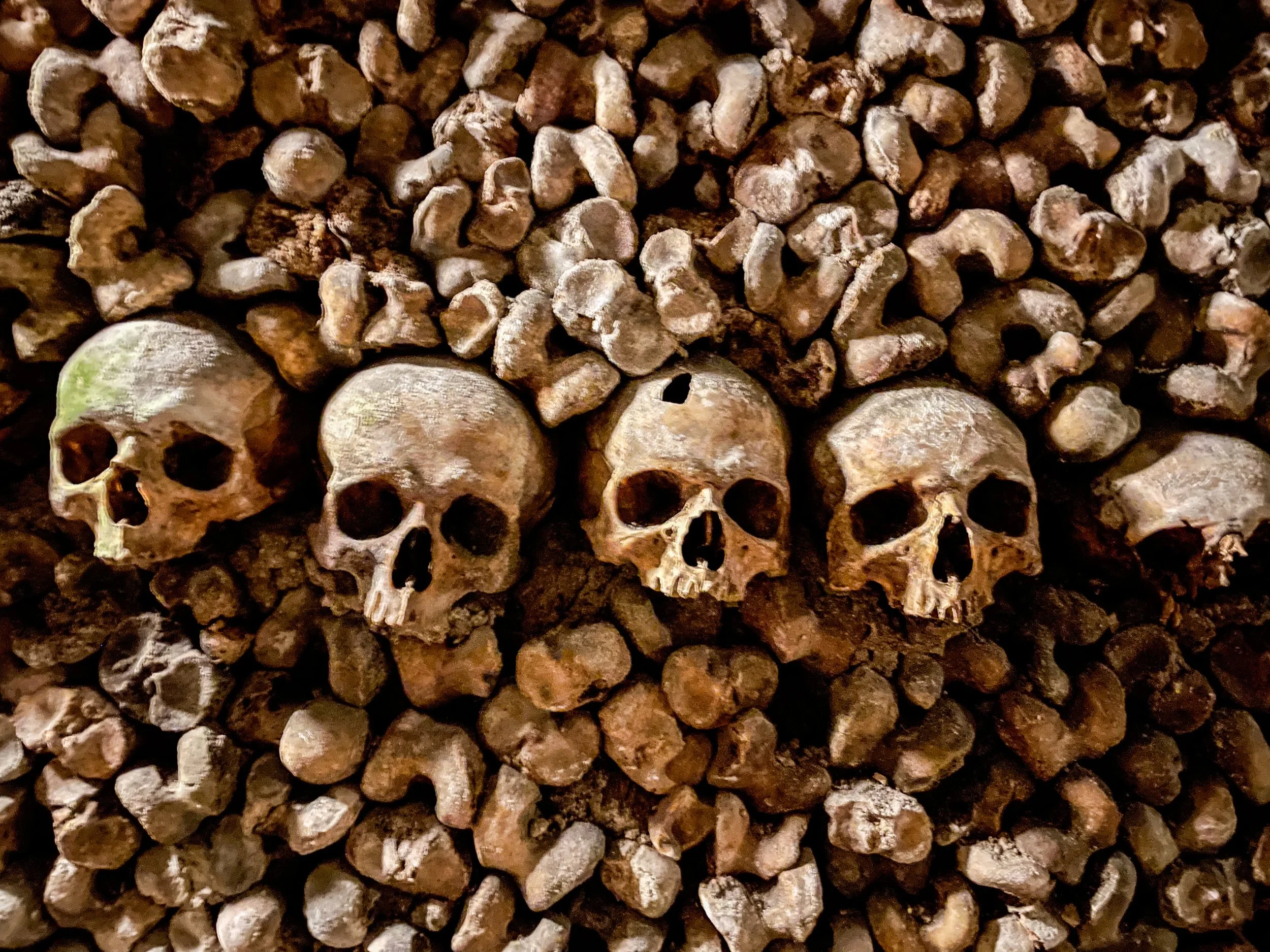


So, you’ve seen the catacombs now. But keep in mind that this is only a very small part of the tunnels underneath Paris are open to the public. Recall that there are 320 km (200 miles) of these ancient tunnels that run underneath Paris. Care to guess the distance covered in this article? Only about 1.5 km. There are sections of bones that are not open to the public as well, but far more empty tunnels just quietly sitting here underneath Paris, silent and undisturbed…
Just kidding. As it turns out, they are disturbed quite frequently by fascinated surface dwellers who come down here to the necropolis to explore, think dark thoughts, or to party! If you ask around in Paris, it won’t take long before you find somebody who knows somebody who has been to (illegal) raves down here! In the early days of this blog, I probably would have tried to get invited to one of these things, but now that I’m in my 30s… nah, I’m good. It definitely holds a VICE-esque appeal to pursue these kinds of ridiculous things, but the reality (I’m told) is that the unofficial access routes to these tunnels are often full of mud and water, and that the people who do this stuff are (…looking for the right adjective…) abnormal. However, I think that, to completely write-off the unofficial goings-on of the Catacombs as a bunch of weird nonsense would be a mistake. There is a fascinating world of events happening in these tunnels, from art installations, to concerts, to a fully equipped underground movie theater—complete with a screen, bar, and restaurant—that was busted in 2004!
These tunnels have actually been a party spot since the very beginning, as there are records masquerade balls and concerts held by candlelight in the catacombs as early as the 1790s. One such event is depicted on the plaque in the gallery below. However, there were also subterranean components of many major political and military events in Paris’s history. For example, covert political meetings were held down here during the French Revolution, and an entirely subterranean battlefield developed in these tunnels during WWII. During the Nazi occupation of Paris from 1940-1944, Nazi forces fought the French Resistance for control over the tunnels. The French Resistance had bases in these tunnels, but there was also a Luftwaffe (German Air Force) command center that was located down here, located beneath the Lycée Montaigne in the 6th arrondissement. When Paris was finally liberated in 1944, there was fighting that took place in these tunnels, so the battle was literally happening on multiple levels of the city. 🤯


And a few minutes later, we were back on the surface, walking the streets of Paris like normal. It’s crazy that this world has just been sitting down here quietly for all these years. And it’s crazier still to contemplate the fact that these tunnels were dug during Roman times! Yes, Paris was once part of the Roman Empire.
But what about that notorious cemetery from the beginning of the article that prompted these catacombs to be built in the first place?
I am happy to report that this cemetery is long gone. Today, Cimetière des Innocents in Les Halles is a beautiful city square in the center of Paris. It’s got a big, ornate fountain in the middle (Fontaine des Innocents), and the space around it is nearly always bustling with street life. It’s hard to be believe that this was once such a grotesque bastion of death. But now, when Parisians think of Les Halles, it’s usually for the metro station; and just like the dragon at the bus stop in Aix, that world is gone.


I’ve been forced to reference Vienna’s history books more than once now, but today is where we’re going to take a deep dive into those history books. And we’re going to do so with the aim of exploring one particular character in Vienna’s story: the House of Habsburg.
The House of Habsburg is one of the most important dynasties in European history. Their origins are bit murky, but their collective ascent to nobility as a family can be traced all the way back to the 900s. They were lords controlling patches of territory in central Europe who—over the course of generations—fought their way to the very top. Starting in 1440 when they were at the helm of the Holy Roman Empire, the Habsburgs were in control of major world powers until the early 1900s.